
What if I told you that you’re missing out on a $13 Trillion segment of e-commerce customers? Well, you probably are. In this article we’ll explain how, why and what you can do about it.
Even when they’ve shown interest in your goods and services, less than 30% of those browsing your Shopify store will actually spend their hard-earned cash and make a purchase.
But, what you might not know, is you’re leaving even more money on the table by not allowing a huge sector to even enter your online store.
People with disabilities are shut out of the vast majority of websites, especially eCommerce websites.
Representing roughly 15% of the world’s population, members of the various disability communities command more than $13 trillion in expendable income.
That’s money that they could be spending on your products.
You can fix this problem by ensuring your Shopify website is accessible to people with disabilities.
Chances are, your Shopify store isn’t fully accessible
For a website to be accessible to people with disabilities, it needs to conform to the Web Content Accessibility Guidelines, or WCAG, as it is commonly referred to. Created by the World Wide Web Consortium, WCAG is the most prominent set of web accessibility standards in the world. It also plays an integral role in regards to web accessibility laws, such as the Americans with Disabilities Act (ADA), the Accessibility for Ontarians with Disabilities Act (AODA), and the European Accessibility Act (EAA).
For your Shopify website to fully conform to WCAG, it needs to to meet a long list of design and technical criteria.
Some of the most important criteria include, but certainly aren’t limited to:
-
- Ensuring your website can be navigated entirely via keyboard
-
- Ensuring your website is fully compatible with assistive technologies like screen readers (e.g., JAWs for Microsoft apps).
-
- Alt text is added to all images conveying critical information
-
- Full and accurate captions have been added to all meaningful video content
-
- Ensuring sufficient color contrasts throughout your website, and not just between text and its background
-
- Ensuring your website is fully responsive
-
- Proper heading structures are applied throughout the website
Less than 4% of the world’s websites meet WCAG’s criteria.
As eCommerce websites feature more complex elements than regular sites, the percentage of Shopify sites that fully conform to WCAG is even smaller.
The problems with relying on Shopify’s built-in accessibility features
So, what does Shopify offer its customers to address these accessibility issues?
Well, not much.
In its own accessibility statement, Shopify stresses its ongoing commitment to ensure users can create accessible online stores with its platform. Yet, many Shopify themes suffer from significant accessibility issues, most notably missing ARIA labels. The latter are HTML roles and attributes that help address the limitations of regular HTML code in terms of accessibility, and are critical for screen readers.
Shopify offers a number of detailed resources that developers can use to test Shopify stores for accessibility. However, there are no built-in comprehensive solutions that tackle accessibility issues effectively and efficiently.
The solution: A Shopify accessibility app
Shopify’s true strength is in its wealth of apps.
And, just like you should rely on a designated app to ensure your Shopify store is fully optimized for SEO, you should do the same when it comes to accessibility.
There are number of good accessibility apps on the app store. Yet, few are as comprehensive and robust as Web Accessibility by accessiBe. Created by accessiBe (one of the world’s leaders in web accessibility technology), accessWidget seamlessly integrates into any Shopify store.
Then, two things happen:
-
- accessWidget will run an automated audit of your Shopify store’s code, identifying accessibility issues. Once found, accessWidget automatically applies the necessary changes to the problematic code. This fixes the ‘heavier’ elements of web accessibility, such as allowing for keyboard-only navigation and screen reader compatibility
At this point, your Shopify store reaches full conformance with WCAG and is fully accessible.
-
- Your website visitors will be presented with a really cool user interface, which they can prompt by clicking on an icon at the bottom of their screen:
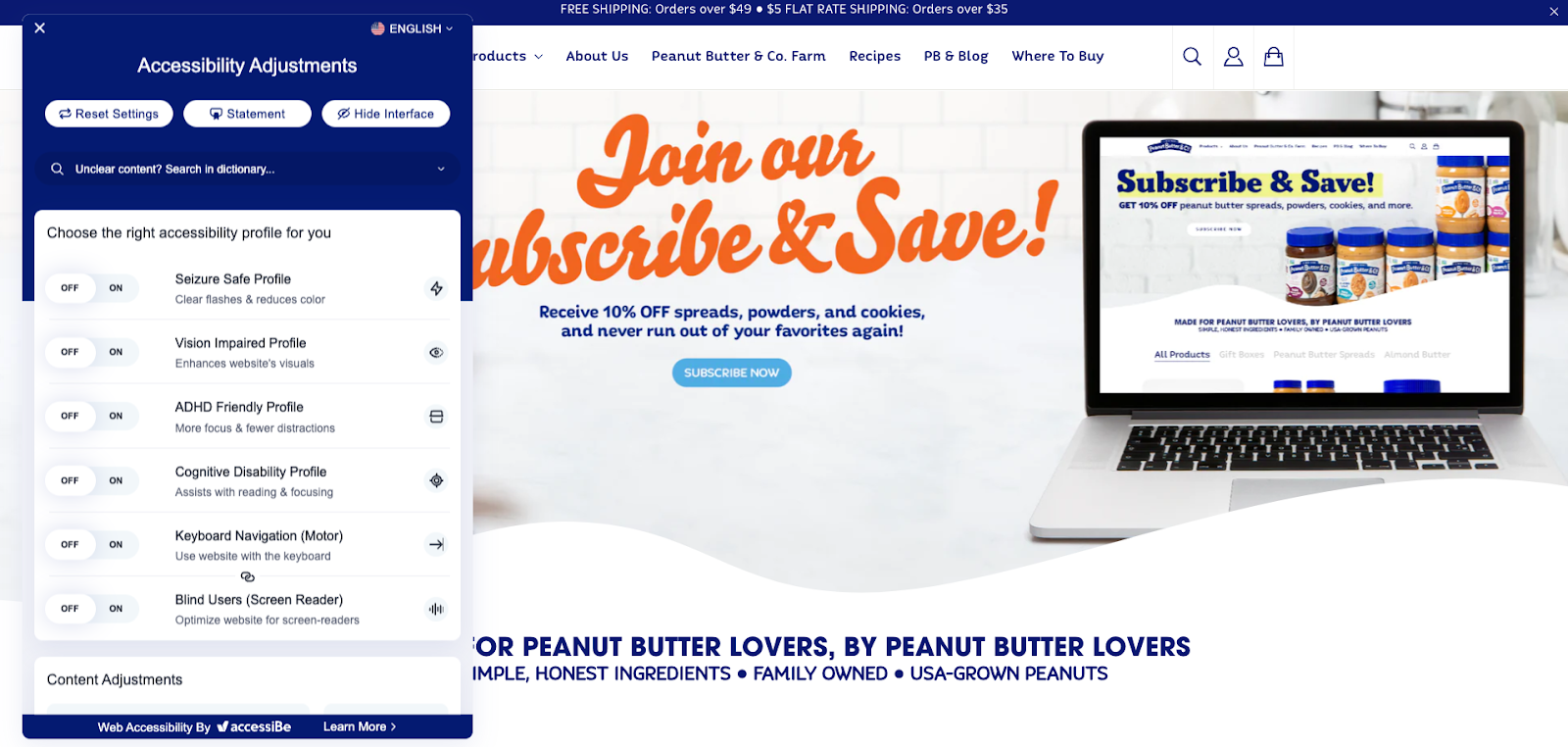
This allows shoppers to adjust design and UI elements to fit their unique needs. People with vision impairments, for example, can increase text size, select more legible fonts, and adjust color contrasts.
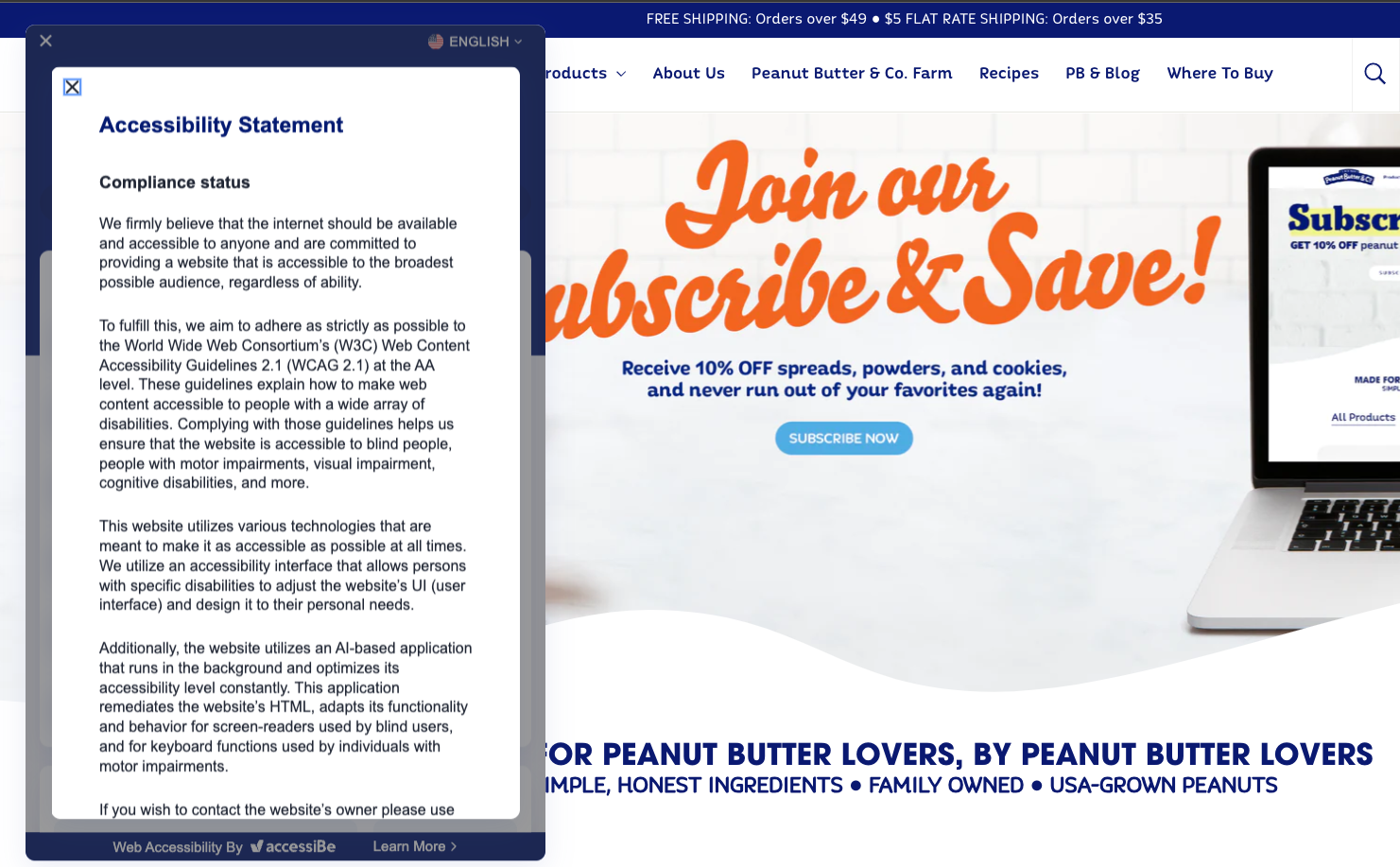
Another cool thing about the user interface (or the widget) is that it hosts your accessibility statement:

The right Shopify app will help you achieve legal compliance
It is important to note that you are very likely mandated by law to ensure your Shopify store is accessible to people with disabilites. Many U.S courts apply the Americans with Disabilties Act (ADA) to websites, and reference WCAG as the standard sites should conform to under the law.
There are a number of other laws that mandate web accessibility, such as the Accessibility for Ontarians with Disabilties Act (AODA), and Section 508 of the Rehabilaition Act, which applies to federally-backed organizations, and to those providing services to such bodies.
Starting in 2025, the European Accessibility Act (EAA) will officially mandate web accessibility within the European Union. WCAG conformance will likely ensure your store complies with this law, when it is enforced.
When you use an accessibility app, like accessWidget, you ensure your site complies with these laws.
Shopify apps: The true strength of the world’s leading eCommerce platform
Shopify’s basic accessibility features shouldn’t discourage you from ensuring you appeal to all potential customers. Just like with other areas of your store (like SEO, UGC, quizzing, and general management), Shopify encourages you to explore its app store to find the perfect accessibility solution. When you use an accessibility app, like Web Accessibility by accessiBe, you address accessibility in a holistic way, and ensure your store maintains its accessibility status through every update and tweak in its design and functionality. With your customers potentially legally obligated to ensure they are fully inclusive, the right app will help them comply with relevant laws, and avoid costly legal recourse.
Thanks for reading about the importance of accessibility. This post was written in association with accessiBe
| About the author: | |
 |
Yoni Yampolsky is a Marketing an Growth Manager for accessiBe. One of the world’s leaders in developing comprehensive web accessibility solutions, accessiBe is determined to help create a more fair and equitable web. |
You must be logged in to post a comment.