

A real Shopify store, anonymized but with real numbers — eight months of flat organic traffic, zero prior SEO work, and what 14 days of targeted fixes actually did to the graph.
This is a Shopify SEO case study about a real store — anonymized, but with real numbers.
A premium artisanal brand. Niche product, serious craft, small but loyal customer base. The organic traffic graph wasn’t crashing — it was just flat. Stuck. Month after month, the line barely moved. Like a shop with a great product in the window and no sign above the door.
No Google penalty. No algorithm hit. Just traffic that had never grown, because the store had never given Google a reason to send it anywhere.
When we ran the audit, the answer was immediate. This store had never worked on its SEO. At all.
A premium brand with no SEO setup is invisible to Google — even if it’s visible to customers
The store looked fine from the inside. Products were live. Orders were coming in. The brand had a clear identity and a quality product.
From Google’s perspective, almost nothing was readable.
Every product page had a meta title that defaulted to the product name — no keyword, no context, no signal. Meta descriptions were blank. Product descriptions were thin. Image alt text was missing across the catalog. No schema had ever been installed, so Google and every AI search engine (ChatGPT, Perplexity, Google AI Overviews) had no structured data to work with.
The GEO score — a measure of how well AI engines can understand and cite a site — was 45 out of 100. Every AI citation we checked had the brand name spelled wrong.
The store wasn’t declining because something broke. It was declining because SEO had never been built. The traffic that did exist was coasting on whatever Google had pieced together on its own. With no foundation to sustain it, that traffic had been eroding for months.
Where the store started:
- Traffic from Google: ~120 visits a month — roughly the size of a school classroom, for a store with hundreds of products
- Findability: Only 54 keywords showing up in search results. Like a shop with hundreds of products on the shelves but almost no signage — most of it invisible to anyone walking past
- AI visibility: ChatGPT and Perplexity were mentioning the brand — but spelling the name wrong every time
The good news: a store with no SEO foundation doesn’t have a complex problem. It has an unfilled one. And unfilled is faster to fix than broken.
- 8 months of declining traffic with no SEO foundation
- Brand name misspelled by every AI search engine
- Meta titles defaulted to product names, no keywords
- Organic traffic reversed within 30 days of fixes
- Schema installed — brand identity corrected immediately
- Keyword-optimised titles across every product and collection
The Quick Start Service fixes your SEO foundation in 14 days. Full audit, meta titles, schema, broken links — done for you with a money-back guarantee.
Get the foundation done →What the Quick Start Service fixed — and in what order
A Shopify SEO audit produces a priority list. You fix what affects the most pages first, then work down.
Every page was missing the basics: titles, descriptions, and alt text
The single biggest gap was on-page content. None of it had been set intentionally across the catalog.
Meta titles and descriptions tell Google what keyword each page should rank for and give searchers a reason to click. Without them, Google guesses — usually pulling the product name and a random line of text, which is rarely what a customer is actually searching. Product titles and descriptions give Google the language of the page. Image alt text tells Google what the photos show, because Google can’t see images — only text.
Every surface that carries text is either sending a signal or missing a chance to. This store was missing almost all of them.
200 target keywords were added across global settings and individual products and collections. Meta titles and descriptions were written for every page. Product titles were updated. Product descriptions were rewritten with keyword context, occasion language, and structure — the kind of copy that gives both Google and a customer a reason to be on the page. Plug In AI handled the description generation across the full catalog in bulk. Image alt text was generated for all products and collections.
After this step:
- Products SEO score: 39 → 64 (+25 points)
- Collections SEO score: 45 → 73 (+28 points)
Broken links fixed
The audit surfaced 16 broken links — pages that had once existed but now returned 404 errors. Each one was a crawler dead end and a lost signal. A customer clicking an old link from Google, an email, or a saved bookmark would land on a blank error page.
Every broken link with meaningful traffic was redirected to the most relevant existing page. Not the homepage — the right page. That distinction matters: redirecting to the homepage tells Google the searcher didn’t get what they needed, which is the opposite of what you want a redirect to signal.
Schema: Organization, WebSite, Product
Schema is the layer of structured data that tells Google and AI search engines who a site is, what it sells, and how to describe it. Without schema, AI engines piece this together themselves — which is how you end up with your brand name misspelled in every citation.
This store had no schema at all. Three types were installed: Organization (who the brand is), WebSite (basic site metadata), and Product (individual product information). The brand name misspelling was corrected on day one — the moment Organization schema was in place with the correct entity name.
Before schema was installed, AI search engines like ChatGPT and Perplexity were constructing their own description of the brand from whatever fragments they could find. The result: wrong name, incomplete information, inconsistent citations. Schema tells AI engines exactly who you are and what you sell. It’s the fastest fix for AI visibility — and it takes minutes to install.
Frequently asked questions about Shopify SEO results
How long does it take to see SEO results after fixing meta titles and schema on Shopify?
For a store that has never set up SEO, results can appear within 2–4 weeks of implementing changes. Google recrawls pages after updates, and when it finds keyword-optimised meta titles and structured data for the first time, it has new information to work with. The timeline depends on crawl frequency — stores with more backlinks and traffic tend to get recrawled faster.
What does a Shopify SEO audit check first?
Start with meta titles and descriptions. If those aren’t set, every other fix is secondary — meta titles are the strongest on-page keyword signal Google uses to understand what a page should rank for. After that: product descriptions, image alt text, broken links, and schema. That’s the order we work through in every Quick Start Service engagement.
Can missing meta titles really cause organic traffic to decline over time?
Yes. A store with blank or default meta titles gives Google nothing to match against keyword searches. Over time, without keyword signals, pages that were ranking on residual authority gradually lose ground to pages that have explicit keyword targets. The decline is slow and easy to ignore — until you look at a year’s worth of data.
What is the Shopify Quick Start SEO Service?
The Quick Start Service is a done-for-you SEO setup for Shopify stores. In 14 days, we run a full audit using Ahrefs, set keyword targets, write meta titles and descriptions for every product and collection, fix broken links, and install schema. The work is done inside Plug In SEO and Plug In AI. It’s a one-time engagement — not ongoing management — designed to build the SEO foundation the store has been missing.
Does fixing schema improve AI search visibility on Shopify?
Yes. Schema gives AI search engines — Google AI Overviews, ChatGPT, Perplexity — structured information about who a brand is and what it sells. Without schema, AI engines construct this information from whatever they can find, which produces inconsistent and sometimes incorrect results. Organization schema in particular fixes brand identity issues: misspellings, wrong descriptions, incomplete citations. It’s one of the highest-impact, lowest-effort fixes available for AI visibility.
The graph after 14 days — and how to get the same work done on your store
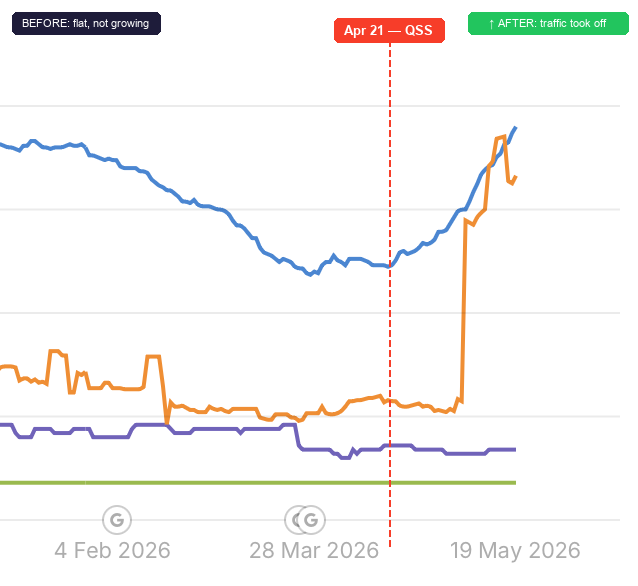
Within 30 days of the Quick Start Service, organic traffic reversed. The 8-month decline stopped. The line on the Ahrefs graph turned upward.
The most important thing the graph proves isn’t a specific traffic number. It’s that the fundamentals still work. A premium Shopify store with a real product, a real audience, and zero prior SEO investment — fix the meta titles, fix the broken links, install the schema — and the traffic responds. SEO isn’t dead. The foundation just has to be there.
For a store in the same situation, there are two paths:
Done for you — Quick Start Service
We run the full audit, set up Plug In SEO and Plug In AI, write every meta title, description, and alt text, fix broken links, and install schema. One-time engagement, 14 days, money-back guarantee. Built for stores that want the foundation done correctly without doing it themselves.
Get the foundation done in 14 days →Do it yourself: